
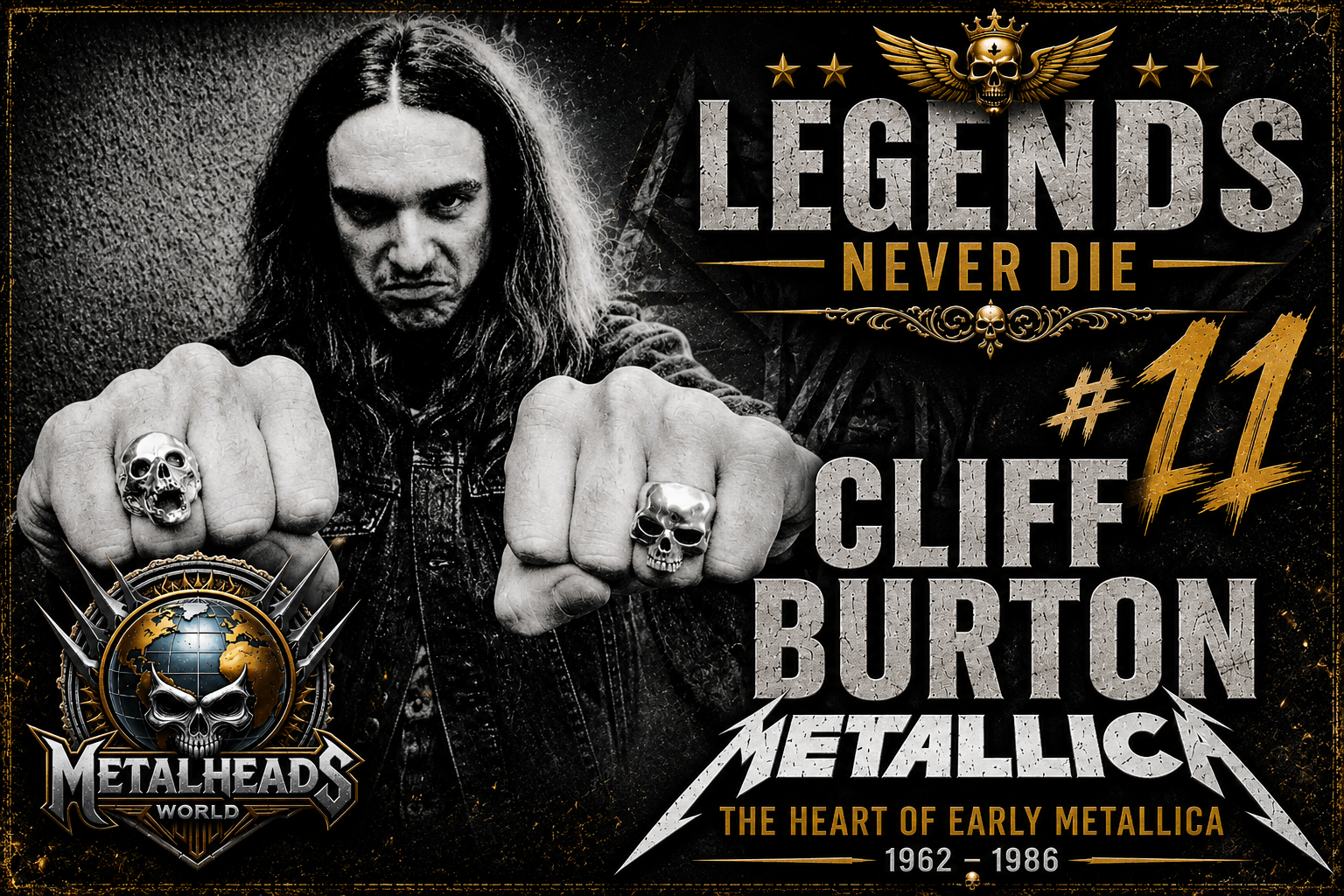
In den frühen Morgenstunden des 27. September 1986 herrschte Stille auf einer Landstraße nahe Dörarp in Schweden.
Metallica befanden sich mitten auf ihrer europäischen Tournee.
Die Band war auf dem Weg zur Weltspitze.
Master Of Puppets hatte ihnen die Türen zu einer neuen Dimension geöffnet.
Die Zukunft gehörte ihnen.
Doch innerhalb weniger Sekunden änderte sich alles.
Der Tourbus geriet außer Kontrolle.
Er überschlug sich.
Als die Rettungskräfte eintrafen, war Cliff Burton tot.
Er wurde nur 24 Jahre alt.
Doch obwohl sein Leben viel zu früh endete, hinterließ er ein Vermächtnis, das bis heute Generationen von Musikern beeinflusst.
Für viele Fans war Cliff Burton nicht einfach nur der Bassist von Metallica.
Er war das kreative Herz der frühen Band.
Der Musiker, der Metallica musikalisch in neue Dimensionen führte.
DER SCHICKSALSSCHLAG, DER ALLES VERÄNDERTE
Clifford Lee Burton wurde am 10. Februar 1962 in Castro Valley, Kalifornien geboren.
Schon als Kind spielte Musik eine wichtige Rolle in seinem Leben.
Doch ein tragisches Ereignis sollte ihn für immer prägen.
Sein älterer Bruder Scott starb im Alter von nur 16 Jahren an einem Gehirnaneurysma.
Der Verlust erschütterte die gesamte Familie.
Später erzählte Cliffs Vater, dass sein Sohn nach dem Tod seines Bruders gesagt habe:
„Ich werde der beste Bassist werden, für meinen Bruder.“
Ob der Wortlaut exakt so fiel, wird bis heute diskutiert.
Doch fest steht:
Der Tod seines Bruders wurde zu einer enormen Motivation für Cliff.
DER KLASSISCHE MUSIKER IM METAL
Während viele junge Musiker ausschließlich Hard Rock hörten, interessierte sich Cliff für weit mehr.
Er studierte:
- Johann Sebastian Bach
- Ludwig van Beethoven
- Frédéric Chopin
Er beschäftigte sich mit Harmonielehre, Melodien und klassischen Kompositionen.
Diese Einflüsse sollten später einen enormen Einfluss auf Metallica haben.
Viele der epischen und melodischen Elemente der frühen Band tragen seine Handschrift.
TRAUMA UND DIE ENTDECKUNG
Vor Metallica spielte Cliff in der Band:
Trauma
1982 trat die Gruppe im legendären Whisky A Go Go in Los Angeles auf.
Unter den Zuschauern befanden sich:
- James Hetfield
- Lars Ulrich
Sie konnten ihren Augen kaum trauen.
Nicht wegen der Band.
Sondern wegen des Bassisten.
Cliff spielte seinen Bass über einen Wah-Wah-Effekt und ließ ihn wie eine Leadgitarre klingen.
Sofort war klar:
Diesen Musiker mussten sie haben.
DIE BEDINGUNG
Metallica wollten Cliff sofort verpflichten.
Doch Cliff stellte eine Bedingung.
Er wollte nicht nach Los Angeles ziehen.
Die Szene dort gefiel ihm nicht.
Wenn Metallica ihn wollten, mussten sie nach San Francisco ziehen.
Und genau das geschah.
Die Band zog in die Bay Area.
Schon dieser Schritt zeigt, welchen Stellenwert Cliff Burton innerhalb der jungen Metallica hatte.
KILL ‚EM ALL
1983 erschien:
Kill ‚Em All
Das Album gilt heute als Geburtsstunde des Thrash Metal.
Doch ein Song ragte besonders heraus:
Anesthesia (Pulling Teeth)
Ein fast vierminütiges Bass-Solo.
Im Heavy Metal war so etwas damals nahezu unvorstellbar.
Cliff zeigte der Welt, dass ein Bass weit mehr sein konnte als ein Begleitinstrument.
Für unzählige Musiker wurde dieser Song zur Offenbarung.
RIDE THE LIGHTNING
Mit dem zweiten Album entwickelte sich Metallica rasant weiter.
Cliffs Einfluss wurde immer deutlicher.
Er brachte neue musikalische Ideen ein.
Mehr Melodie.
Mehr Dynamik.
Mehr Tiefe.
Songs wie:
- Fade To Black
- For Whom The Bell Tolls
- Creeping Death
zeigten erstmals, dass Metallica weit über klassischen Thrash Metal hinausgehen konnte.
Besonders die berühmte Bass-Einleitung von For Whom The Bell Tolls zählt heute zu den bekanntesten Momenten der Metal-Geschichte.
MASTER OF PUPPETS
1986 erschien das Album, das viele bis heute als das größte Metal-Album aller Zeiten betrachten:
Master Of Puppets
Für Cliff Burton war es der kreative Höhepunkt seiner Karriere.
Besonders deutlich wird sein Einfluss auf:
Orion
Das Instrumentalstück gilt als sein musikalisches Vermächtnis.
Die harmonischen Passagen.
Die Melodien.
Die Atmosphäre.
All das trägt unverkennbar Cliffs Handschrift.
Bis heute gehört Orion zu den beliebtesten Instrumentals der Metal-Geschichte.
DER MENSCH CLIFF BURTON
Cliff war anders als viele Musiker seiner Zeit.
Während andere Partys feierten, beschäftigte er sich mit:
- Geschichte
- Literatur
- Philosophie
- klassischer Musik
Er las Bücher.
Er diskutierte über Politik und Kunst.
Viele Weggefährten beschrieben ihn als den intellektuellsten Musiker innerhalb von Metallica.
Gleichzeitig blieb er bodenständig.
Ruhig.
Authentisch.
Genau deshalb wurde er von Fans und Bandkollegen gleichermaßen geschätzt.
DAS KARTENSPIEL
Die Geschichte gehört heute zu den bekanntesten Momenten der Metal-Geschichte.
Während der Europa-Tournee 1986 stritten Cliff Burton und Kirk Hammett um die Schlafkojen im Tourbus.
Die beiden zogen Karten.
Cliff gewann.
Er durfte in Kirks Koje schlafen.
Niemand ahnte, welche Bedeutung dieser Moment wenige Stunden später bekommen würde.
DAS BUSUNGLÜCK
Am Morgen des 27. September 1986 verlor der Fahrer des Tourbusses nahe Dörarp in Schweden die Kontrolle über das Fahrzeug.
Der Bus kam von der Straße ab und überschlug sich.
Cliff Burton wurde aus dem Bus geschleudert.
Das Fahrzeug landete auf ihm.
Er starb noch am Unfallort.
Die Band war geschockt.
James Hetfield suchte später die Unfallstelle ab und versuchte zu verstehen, was passiert war.
Bis heute ranken sich zahlreiche Diskussionen um die genaue Ursache des Unglücks.
Fest steht jedoch:
Der Heavy Metal verlor einen seiner außergewöhnlichsten Musiker.
Mit nur 24 Jahren.
METALLICA AM ABGRUND
Nach Cliffs Tod stand die Zukunft der Band auf der Kippe.
James Hetfield und Lars Ulrich wussten nicht, ob sie weitermachen sollten.
Der Verlust war enorm.
Nicht nur musikalisch.
Auch menschlich.
Monatelang herrschte Unsicherheit.
Erst später entschied sich die Band, weiterzumachen.
Jason Newsted übernahm schließlich den Bass.
Doch Cliff Burton konnte niemand ersetzen.
TO LIVE IS TO DIE
1988 veröffentlichten Metallica das Album:
…And Justice For All
Darauf befand sich ein Instrumentalstück mit dem Titel:
To Live Is To Die
Das Stück basiert teilweise auf musikalischen Ideen von Cliff Burton.
Für viele Fans ist es der endgültige Abschiedsgruß der Band an ihren gefallenen Freund.
Bis heute gehört es zu den emotionalsten Momenten der gesamten Metallica-Geschichte.
CLIFF BURTON DAY
Im Jahr 2018 erklärte Alameda County in Kalifornien den 10. Februar offiziell zum:
Cliff Burton Day
Eine außergewöhnliche Ehrung.
Selbst Jahrzehnte nach seinem Tod wird sein Einfluss offiziell gewürdigt.
Nur wenige Metal-Musiker haben eine vergleichbare Anerkennung erhalten.
DAS VERMÄCHTNIS
Cliff Burton spielte nur drei Studioalben mit Metallica ein.
Doch sein Einfluss reicht weit darüber hinaus.
Er half dabei, aus einer jungen Thrash-Metal-Band eine musikalische Institution zu formen.
Seine Ideen leben in vielen der größten Metallica-Klassiker weiter.
Generationen von Bassisten nennen ihn bis heute als wichtigsten Einfluss.
Und viele Fans fragen sich noch immer:
Wie hätte sich Metallica entwickelt, wenn Cliff Burton nicht gestorben wäre?
Eine Antwort wird es nie geben.
Doch genau dieses Geheimnis macht seine Geschichte noch faszinierender.
WARUM LEGENDS NEVER DIE
Wenn irgendwo auf der Welt die ersten Töne von:
- For Whom The Bell Tolls
- Fade To Black
- Master Of Puppets
- Orion
- Creeping Death
- Anesthesia (Pulling Teeth)
erklingen,
lebt Cliff Burton weiter.
In seinen Basslinien.
In seinen Kompositionen.
In seinem Einfluss auf Generationen von Musikern.
Und in den Herzen von Millionen Metal-Fans.
Er war nicht nur der Bassist von Metallica.
Er war ihr kreativer Motor.
Ihr Visionär.
Ihr verlorenes Genie.
Eine Ikone.
Ein Pionier.
Eine Legende.
Denn manche Musiker sterben jung.
Doch ihre Musik bleibt für immer.
LEGENDS NEVER DIE.
LEGENDS NEVER DIE #11
CLIFF BURTON – THE YOUNG MAN WHO CHANGED METALLICA FOREVER
In the early hours of September 27, 1986, silence filled a lonely road near Dörarp, Sweden.
Metallica were in the middle of their European tour.
The band was on its way to becoming one of the biggest names in heavy metal.
Master Of Puppets had opened the door to a new dimension.
The future belonged to them.
Then, within seconds, everything changed.
Their tour bus lost control.
It overturned.
When emergency crews arrived, Cliff Burton was dead.
He was only 24 years old.
Yet despite a life cut tragically short, Cliff Burton left behind a legacy that continues to inspire generations of musicians around the world.
For many fans, he was far more than Metallica’s bassist.
He was the creative heart of the early band.
The musician who helped transform Metallica into something far greater than a simple thrash metal act.
THE TRAGEDY THAT SHAPED HIS LIFE
Clifford Lee Burton was born on February 10, 1962, in Castro Valley, California.
Music played an important role in his life from an early age.
But a devastating tragedy would shape his future forever.
His older brother Scott died from a brain aneurysm at the age of sixteen.
The loss deeply affected the entire family.
Years later, Cliff’s father recalled that Cliff vowed to become the greatest bassist he could possibly be in honor of his brother.
Whether the exact words are known or not, there is no doubt that Scott’s death became one of the driving forces behind Cliff’s determination and dedication.
THE CLASSICAL MUSICIAN INSIDE A METALHEAD
Unlike many young musicians who focused solely on rock music, Cliff developed a deep appreciation for classical composers.
Among his influences were:
- Johann Sebastian Bach
- Ludwig van Beethoven
- Frédéric Chopin
He studied harmony, melody, and composition.
These influences would later become a crucial part of Metallica’s musical evolution.
Many of the band’s epic and melodic moments can be traced directly to Cliff Burton’s vision.
TRAUMA AND THE DISCOVERY
Before joining Metallica, Cliff played in a band called:
Trauma
In 1982, Trauma performed at the legendary Whisky A Go Go in Los Angeles.
Among those watching were:
- James Hetfield
- Lars Ulrich
They were stunned.
Not by the band.
But by the bassist.
Cliff used a wah-wah pedal and played his bass like a lead instrument.
The moment they saw him perform, they knew they had found the missing piece of Metallica.
THE CONDITION
Metallica wanted Cliff immediately.
But Cliff had one condition.
He refused to relocate to Los Angeles.
He preferred the San Francisco Bay Area scene.
So he told the band:
If you want me, move north.
Remarkably, Metallica agreed.
The band relocated to the Bay Area.
That decision alone shows how highly Cliff Burton was valued even before officially joining the group.
KILL ‚EM ALL
In 1983 Metallica released:
Kill ‚Em All
Today it is considered one of the founding albums of thrash metal.
One track stood out above all others:
Anesthesia (Pulling Teeth)
A nearly four-minute bass solo.
At the time, such a thing was almost unheard of in heavy metal.
Cliff proved that the bass guitar could be every bit as exciting and expressive as a lead guitar.
For countless bass players, it was a life-changing moment.
RIDE THE LIGHTNING
Metallica’s second album showed dramatic musical growth.
Cliff’s influence became impossible to ignore.
He brought melody.
Dynamics.
Sophistication.
Depth.
Songs such as:
- Fade To Black
- For Whom The Bell Tolls
- Creeping Death
demonstrated that Metallica could become far more than just a fast thrash metal band.
The iconic bass introduction to For Whom The Bell Tolls remains one of the most recognizable moments in metal history.
MASTER OF PUPPETS
In 1986 Metallica released what many fans still consider the greatest metal album ever recorded:
Master Of Puppets
For Cliff Burton, it represented the creative peak of his career.
Nowhere is his influence more evident than on:
Orion
The instrumental masterpiece is often regarded as Cliff Burton’s musical monument.
Its harmonies, melodies, and atmosphere bear his unmistakable signature.
To this day, Orion is considered one of the greatest instrumental tracks ever written.
THE MAN BEHIND THE MUSIC
Cliff Burton was different from many musicians of his era.
While others partied, Cliff spent his time exploring:
- Literature
- History
- Philosophy
- Classical music
He loved reading.
He enjoyed intellectual discussions.
Many friends and colleagues described him as the most thoughtful and intelligent member of Metallica.
Yet he remained humble and genuine.
That authenticity earned him enormous respect from both fans and fellow musicians.
THE CARD GAME
One of the most famous stories in metal history took place during Metallica’s 1986 European tour.
Cliff Burton and Kirk Hammett drew cards to determine who would get the better sleeping bunk on the tour bus.
Cliff won.
He took Kirk’s bunk.
Nobody could have imagined the significance of that moment.
Only hours later, tragedy struck.
THE BUS CRASH
On September 27, 1986, Metallica’s tour bus crashed near Dörarp, Sweden.
Cliff Burton was thrown from the vehicle.
The bus rolled over and landed on him.
He died at the scene.
The band was devastated.
James Hetfield later searched the crash site, struggling to understand what had happened.
To this day, discussions continue about the exact cause of the accident.
What remains undisputed is that heavy metal lost one of its most extraordinary talents.
At just twenty-four years old.
METALLICA ON THE BRINK
Following Cliff’s death, Metallica’s future was uncertain.
James Hetfield and Lars Ulrich questioned whether the band should continue.
The loss was devastating.
Musically.
Personally.
Emotionally.
Eventually, the band decided to move forward.
Jason Newsted joined as bassist.
But nobody could ever truly replace Cliff Burton.
TO LIVE IS TO DIE
In 1988 Metallica released:
…And Justice For All
Included on the album was:
To Live Is To Die
The instrumental contains musical ideas developed by Cliff Burton.
For many fans, it serves as Metallica’s final farewell to their fallen friend.
It remains one of the most emotional pieces in the band’s entire catalog.
CLIFF BURTON DAY
In 2018, Alameda County officially declared February 10:
Cliff Burton Day
A remarkable honor.
Decades after his death, his impact continues to be formally recognized.
Few metal musicians have received such lasting recognition.
THE LEGACY
Cliff Burton recorded only three studio albums with Metallica.
Yet his influence stretches far beyond those records.
He helped transform a young thrash metal band into a musical institution.
His ideas continue to live on in some of Metallica’s greatest songs.
Generations of bass players cite him as their primary inspiration.
And many fans still ask the same question:
What would Metallica have become if Cliff Burton had lived?
No one will ever know.
But that mystery only makes his story even more powerful.
WHY LEGENDS NEVER DIE
Whenever the opening notes of:
- For Whom The Bell Tolls
- Fade To Black
- Master Of Puppets
- Orion
- Creeping Death
- Anesthesia (Pulling Teeth)
echo through speakers anywhere in the world,
Cliff Burton lives on.
In his bass lines.
In his compositions.
In his influence.
In the countless musicians he inspired.
He was not simply Metallica’s bassist.
He was their creative engine.
Their visionary.
Their lost genius.
A pioneer.
An icon.
A legend.
Because some musicians leave us far too soon.
But their music lives forever.
LEGENDS NEVER DIE.
Über den Autor


