
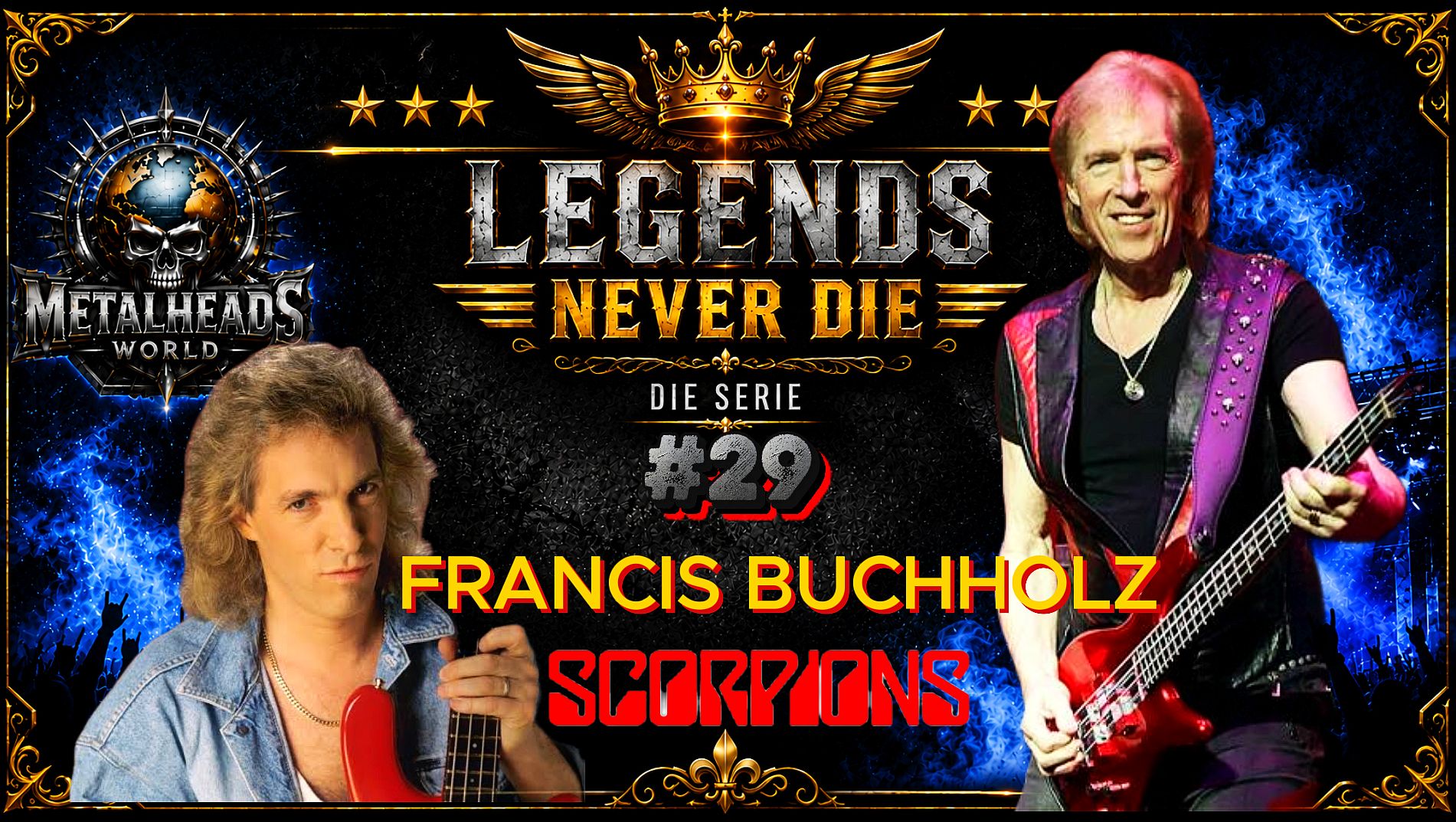
Es gibt Bassisten, die im Hintergrund bleiben.
Und es gibt Bassisten, ohne die der Sound einer Band niemals derselbe gewesen wäre.
Francis Buchholz gehörte genau zu dieser seltenen Kategorie.
Mit seinem druckvollen, präzisen Bassspiel war er über zwei Jahrzehnte das Fundament der Scorpions und trug entscheidend dazu bei, dass aus einer deutschen Hard-Rock-Band eine der erfolgreichsten Rockbands der Welt wurde.
Er stand selten im Rampenlicht.
Doch ohne ihn wären viele der größten Scorpions-Klassiker undenkbar.
DIE ANFÄNGE
Francis Buchholz wurde am 19. Februar 1954 in Hannover geboren.
Schon früh begeisterte er sich für Rockmusik und begann Bass zu spielen.
Ende der 1960er Jahre lernte er Rudolf Schenker kennen.
Aus dieser Zusammenarbeit entstand eine musikalische Partnerschaft, die Rockgeschichte schreiben sollte.
DER WEG ZU DEN SCORPIONS
1973 wurde Francis Buchholz festes Mitglied der Scorpions.
Gemeinsam mit Rudolf Schenker, Klaus Meine und später Uli Jon Roth entwickelte sich die Band stetig weiter.
In den folgenden Jahren entstanden Alben, die den Grundstein für den internationalen Erfolg legten.
DER INTERNATIONALE DURCHBRUCH
Mit Alben wie
- In Trance
- Virgin Killer
- Taken By Force
gewannen die Scorpions weltweit immer mehr Fans.
Nach dem Einstieg von Matthias Jabs begann schließlich der endgültige Aufstieg.
Es folgten Klassiker wie
- Lovedrive
- Animal Magnetism
- Blackout
- Love At First Sting
Mit Songs wie
- The Zoo
- No One Like You
- Rock You Like A Hurricane
- Big City Nights
- Still Loving You
wurden die Scorpions zu einer der größten Rockbands der Welt.
Francis Buchholz bildete gemeinsam mit Schlagzeuger Herman Rarebell ein Rhythmusfundament, das den Sound der Band entscheidend prägte.
DER MANN IM HINTERGRUND
Während Klaus Meine, Rudolf Schenker und Matthias Jabs meist im Mittelpunkt standen, arbeitete Francis Buchholz ruhig und zuverlässig im Hintergrund.
Sein Bassspiel war nie überladen.
Es war präzise.
Druckvoll.
Und immer genau das, was der Song brauchte.
Gerade diese Bescheidenheit machte ihn bei Musikern so geschätzt.
DIE WELTTOUREN
In den 1980er Jahren tourten die Scorpions rund um den Globus.
Sie spielten vor Hunderttausenden Fans und wurden zu den ersten westlichen Rockbands, die in der ehemaligen Sowjetunion große Erfolge feierten.
Francis war bei all diesen Meilensteinen ein unverzichtbarer Bestandteil der Band.
DER ABSCHIED
1992 verließ Francis Buchholz die Scorpions nach internen Differenzen über das Management und geschäftliche Entscheidungen.
Nach fast zwanzig Jahren endete damit ein bedeutendes Kapitel der Bandgeschichte.
Später spielte er unter anderem bei Contraband sowie der deutschen Hard-Rock-Band Victory.
DAS VERMÄCHTNIS
Auch wenn Francis Buchholz heute oft weniger Aufmerksamkeit erhält als andere Mitglieder der klassischen Scorpions-Besetzung, bleibt sein Beitrag zur Erfolgsgeschichte der Band unbestritten.
Sein Bass ist auf den Alben zu hören, die die Scorpions zu Weltstars machten.
Millionen Fans kennen seine Arbeit – auch wenn viele seinen Namen zunächst nicht kennen.
WARUM LEGENDS NEVER DIE
Wenn irgendwo auf der Welt die ersten Töne von
- Rock You Like A Hurricane
- Still Loving You
- No One Like You
- The Zoo
- Big City Nights
- Blackout
erklingen,
lebt Francis Buchholz weiter.
In jedem Basslauf.
In jedem Groove.
Und in jedem Konzert, bei dem die Musik der klassischen Scorpions gefeiert wird.
Er war nie der Lauteste auf der Bühne.
Doch er war einer der wichtigsten Bausteine einer der erfolgreichsten Rockbands aller Zeiten.
Ein Ausnahmemusiker.
Ein Teamplayer.
Eine Legende.
Denn manche Bassisten stehen nicht im Rampenlicht.
Sie bilden das Fundament, auf dem Legenden entstehen.
LEGENDS NEVER DIE.
LEGENDS NEVER DIE #29
FRANCIS BUCHHOLZ – THE FOUNDATION OF THE SCORPIONS
Some bass players remain in the background.
Others become the foundation on which legendary bands are built.
Francis Buchholz was one of them.
For nearly two decades, his powerful, precise bass playing formed the backbone of the Scorpions, helping transform a German Hard Rock band into one of the biggest Rock acts in the world.
He rarely stood in the spotlight.
But without him, many of the band’s greatest classics would never have sounded the same.
THE EARLY YEARS
Francis Buchholz was born on February 19, 1954, in Hanover, Germany.
He discovered his passion for music at an early age and soon chose the bass guitar as his instrument.
In the late 1960s, he met guitarist Rudolf Schenker, beginning a musical partnership that would eventually change Rock history.
JOINING THE SCORPIONS
In 1973, Francis became the bassist of the Scorpions.
Together with Rudolf Schenker, Klaus Meine and later Uli Jon Roth, he helped shape the band’s early sound.
Albums such as:
- Fly To The Rainbow
- In Trance
- Virgin Killer
- Taken By Force
established the Scorpions as one of Europe’s most exciting Hard Rock bands.
WORLDWIDE SUCCESS
The arrival of guitarist Matthias Jabs marked the beginning of the band’s most successful era.
With albums including:
- Lovedrive
- Animal Magnetism
- Blackout
- Love At First Sting
the Scorpions became international superstars.
Songs like:
- The Zoo
- No One Like You
- Rock You Like A Hurricane
- Big City Nights
- Still Loving You
became Rock anthems around the world.
Together with drummer Herman Rarebell, Francis created one of the strongest rhythm sections in Hard Rock.
His solid, melodic bass playing gave the Scorpions their unmistakable drive.
THE QUIET PROFESSIONAL
Unlike some of his bandmates, Francis never sought attention.
He focused entirely on the music.
His bass lines were powerful without being flashy.
Precise without being complicated.
Always serving the song.
That professionalism earned him enormous respect among fellow musicians.
CONQUERING THE WORLD
Throughout the 1980s, the Scorpions became one of the world’s biggest touring bands.
They performed in front of hundreds of thousands of fans and made history as one of the first Western Rock bands to achieve major success behind the Iron Curtain.
Francis Buchholz was an essential part of every milestone.
LEAVING THE BAND
In 1992, after nearly twenty years with the Scorpions, Francis left the band following disagreements over management and business decisions.
Although his time with the Scorpions had come to an end, his contribution to the band’s greatest achievements had already secured his place in Rock history.
He later performed with Contraband and the German Hard Rock band Victory.
THE LEGACY
Francis Buchholz may not always receive the same recognition as some of the band’s more visible members, but his impact on the Scorpions‘ success is undeniable.
His bass playing can be heard on the albums that turned the band into global Rock icons.
His steady musicianship became an essential part of the classic Scorpions sound.
WHY LEGENDS NEVER DIE
Whenever the opening notes of
- Rock You Like A Hurricane
- Still Loving You
- No One Like You
- The Zoo
- Big City Nights
- Blackout
are heard anywhere in the world,
Francis Buchholz lives on.
In every bass line.
In every groove.
In every classic Scorpions album that continues to inspire new generations of Rock fans.
He wasn’t the loudest member of the band.
He didn’t need to be.
He was the foundation.
The heartbeat.
The bass player behind one of the greatest Rock bands of all time.
A true musician.
A true professional.
A true legend.
Because some bass players don’t chase the spotlight.
They build the foundation on which legends stand.
LEGENDS NEVER DIE.
Über den Autor


